Recently in Competition Category

Since the dawn of the Industrial Revolution, economies of scale have ruled the day, with massive investments in power plants, pipelines, factories, transmission lines, dams, and highways to more efficiently serve the burgeoning consumption needs of the rising consumer classes. Industrial-era technologies (such as electricity, petrochemicals, and automobiles) were also closely associated with mass production, the assembly line, and centralized, bureaucratic organization, resulting in the rise of organized labor, worker alienation, and growing social stratification.

As we enter the second decade of the new century, however, the "dark satanic mills" of the Industrial Revolution are giving way to a new generation of technologies that promise to change dramatically the societal, economic, and environmental landscape. The information economy powered by the microchip has already begun to revolutionize society by democratizing access to information and empowering the repressed. Indeed, You-Tube, Twitter, and the rapid emergence of the "blogosphere" have spawned a bottom-up revolution in user-generated content.

cleanwater.jpg

Increasingly, the technologies of tomorrow will be decentralized, distributed in character and disruptive to incumbent firms and institutions. It is much cheaper and more energy efficient, for example, to treat drinking water at the point of use, rather than transporting massive quantities of clean water through pipes from treatment plants only to have much of it leak out or be re-contaminated before it reaches its final destination.

Indeed, we are witnessing a dramatic reversal of the logic of scale--the new diseconomies of scale.

Think about it: Over the past decade or so, we have witnessed the rise of: distributed generation of energy, point of use water treatment, community supported agriculture, microbreweries, point of care healthcare, microfinance, and sustainable construction, to name just a few. Indeed, the term "nano" has become de rigeur.

Because existing players in the utility, energy, transport, food, water, and material sectors have so much to lose, however, it is enormously difficult for the entrepreneurs developing such distributed solutions to gain traction in established markets. Yet given their small scale and distributed nature, such clean technologies hold the potential to creatively destroy existing hierarchies, bypass corrupt governments and regimes, and usher in an entirely new age of capitalism that brings widely distributed benefits to the entire human community.

And rather than depending on national governments or paternalistic social engineers to design the future for the aspiring masses, these disruptive new technologies may be best brought forward through the power of capitalism--not the capitalism of the Industrial Revolution, which enriched a few at the expense of many, but rather a new, more dynamic form of global capitalism that will uproot established elites and unseat incumbents by creating opportunity at the base of the economic pyramid on a previously unimagined scale.

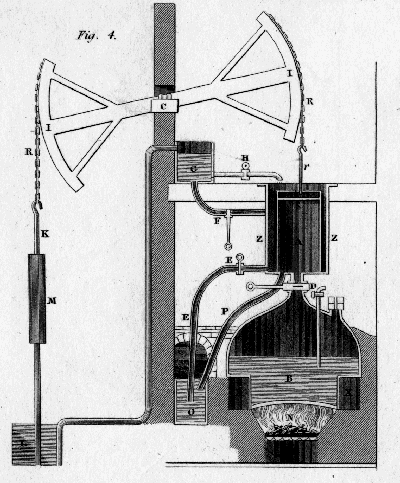
newcomen.gifWhen Thomas Newcomen pumped water out of an English Coal Mine with a makeshift steam engine for the first time in 1722, little did he know that he was giving birth to the defining characteristic of industrial capitalism for the next two centuries--the relentless quest for greater labor productivity.  By substituting coal for manpower, the English textile industry drove the industrial revolution and established the template--and "rules of the game"-- for all industrial enterprises to come.  From cars to chemicals to computer chips, the very concept of "productivity" came to mean producing more product with fewer person-hours of work.

This metric made sense in the 19th century, when coal (and other raw materials) were plentiful and people were relatively scarce.  Now, however, exactly the reverse logic applies--fossil fuels and other raw materials are increasingly scarce and people are relatively plentiful.  We now live with the paradox that increasing business productivity means fewer jobs (especially when economic growth slows), precisely at the time that we need productive employment the most.

Occupy Wall Street, the Arab Spring, the corruption crisis in India, the rural revolt in China--all of these growing social protest movements originate from the same source--a growing "opportunity crisis" driven by unemployment, underemployment, alienation, and humiliation.  The time has come, therefore, to overthrow the tyranny of labor productivity and graduate to a new definition for what it means to be "productive" in business.

wepeople.jpgIn the emerging economies of the world, this revolution has already begun.  ITC in India, for example, prides itself on creating livelihoods for the poor in the rural areas as part of its strategy for wasteland reforestation and agricultural productivity improvement.  Indeed, as commodity costs rise, it may make sense to redefine productivity--from capital intensity and labor efficiency to labor intensity and capital efficiency.  In the 21st century, "sustainable" enterprise must define success by the extent to which they create productive and fulfilling employment for the people of the world. 

Is business up the challenge?

How does business move beyond greening? TOP - “Create needs in existing markets” vs BOP - “Create markets from existing needs.”

Oil painting of Franz Schubert, after an 1825 ...

Image via Wikipedia

When Franz Schubert wrote the first two movements of Symphony No. 8 in B Minor in 1822 (what would come to be known as the "Unfinished Symphony"), little did he know that he was modeling the behavior and skills needed to successfully create the markets of the future at the base of the world income pyramid in the 21st century.

In fact, a full decade after C.K. Prahalad and I first wrote the Fortune at the Bottom of the Pyramid (BoP), few large corporations have yet to realize the vast business potential of the world's four billion poor and underserved:  Most have either sought simply to sell stripped-down versions of their current products to the emerging middle classes in the developing world, or have abandoned the profit motive entirely and moved their BoP initiatives to the corporate social responsibility department or corporate foundation. 

Indeed, it is telling that, as we enter the second decade of the 21st century, the only real BoP business success stories come from the developing world itself--microfinance and mobile telephony for the poor.  Billion dollar companies like Grameen Bank and Grameen Phone in Bangladesh, Compartamos in Mexico, and CelTel in Africa still stand out as the few iconic examples of business success cited by BoP analysts and advocates from around the world.  In fact, no global conference on the topic is complete without significant reference to at least one of these "home run" examples.

This raises the question:  Is there something about microfinance and mobile telephony that has enabled such stunning success?  The answer is yes!  When you examine each of these industries closely, it quickly becomes apparent that each is really a means to an end, rather than an end in itself.  Indeed, microfinance and mobile telephony are not end products, but rather are enabling platforms that facilitate people to accomplish any number of tasks and deliver a wide range of functionalities.  They are, in short, the equivalent of "unfinished symphonies."

Microfinanciers and rural wireless service providers enable poor slum dwellers and villagers to figure out for themselves how best to weave these new services into their lives.  For these customers, this may mean mobile transfer of funds, communicating in code with a loved one, acquiring a third cow, accurate information on crop prices, or expanding a current micro-enterprise.  My colleague Erik Simanis calls these types of products and services value open since they enable people to complete the value proposition for themselves.

Unfortunately, most multinational corporations have chosen BoP strategies that effectively deliver finished symphonies with defined value propositions in the mistaken (though well-intentioned) belief that they know better than the poor themselves what their real needs are.  What works in the established markets at the top of the income pyramid, however, does not work so well in the emerging BoP space.

Time-tested marketing research methods (e.g. consumer surveys, focus groups, ethnographic studies) are excellent ways to uncover new opportunities in already established markets, where low cost or differentiation strategies rule and customers are already accustomed to paying money for service.  However, when it comes to serving the BoP, the challenge is not one of uncovering latent demand, but rather one of creating entirely new markets and industries, where only informality, self-provisioning or barter previously ruled. 

To effectively realize the vast business potential at the base of the pyramid, corporations must thus show a bit of humility.  Companies must come to view the poor more as partners and colleagues rather than merely clients or consumers.  Such an approach calls for deep dialogue (two-way communication) rather than just deep listening.  To realize this mindset shift requires the development of a new "native capability" which focuses on co-creating business concepts and business models with the poor, rather than simply marketing inexpensive versions of top-of-the-pyramid products to low income consumers.

The logic of co-creation does not, however, mean simply entering underserved communities with a completely open mind and no sense of business purpose or direction.  On the contrary, companies must clearly communicate what resources they bring to the table in the form of skills, capabilities, and technological potential; they must do so, however, without prematurely imposing a final product or technological solution.  The aim then is to marry corporate global best practices and technologies from the company with the local knowledge, skills, and aspirations of the local community--to complete the "unfinished symphony" together.

Done well, such an approach to BoP business development holds the potential to create entirely new product and service categories that are embedded in the actual context (rather than simply cheaper versions of existing products from the top of the pyramid).  Embedding also means creating "community pull" for BoP innovations, since they have been co-created with community members, rather than engaging in the expensive and time-consuming process of "social marketing" to educate and promote behavior change among the poor.

Over the past seven years, my colleagues and I have been focused on developing such an approach for companies to effectively co-create new markets in the BoP.  The approach is called the BoP Protocol.  We have now experimented with this approach in a half-dozen different business contexts in Asia, Africa, and Latin America, and have learned a great deal about how to engage local partners and communities in the dance of co-creation.

Many others have also embarked on similar learning journeys to unravel the keys to successfully creating the inclusive businesses of tomorrow that embrace all of humanity and end the scourge of poverty.  My colleague Ted London and I have gathered some of the most important emerging contributions in this regard in a new book, Next Generation Business Strategies for the Base of the Pyramid.

Our conclusion:  There is no "fortune at the bottom of the pyramid" waiting to be discovered.  Instead, the challenge for companies is to learn how to create a fortune with the base of the pyramid.  Franz Schubert's Unfinished Symphony in the 19th century may thus hold the key to a more inclusive form of capitalism for the 21st century.

There is a long-standing narrative in the field of management that goes something like this:  Executives are hired to maximize profits, not social welfare:  Spending shareholders' money on socially responsible but unprofitable endeavors is irresponsible.

Indeed, as stated in a recent Wall Street Journal editorial: "In cases where private profits and public interests are aligned, the idea of corporate social responsibility is irrelevant: companies that simply do everything they can to boost profits will end up increasing social welfare." But, the author argues, "in most cases, doing what's best for society means sacrificing profits...If it weren't, {society's pervasive and persistent} problems would have been solved long ago by companies seeking to maximize their profits."  The ultimate solution, the author argues, "is government regulation."

There is a familiar ring to this argument.  Indeed, The Economist dedicated a special section to the topic in 2005. However, most realize this perspective can be traced to Milton Friedman's famous dictum: "The social responsibility of business is to increase profit."  While many have demonized Friedman for his stance, it turns out--ironically--that he was right!

As he asserted in his classic 1970 article by the same title, it makes little sense for corporate managers to spend the shareholders' money on pet philanthropic projects that have little or no connection to the company's work.  In fact, the core premise of "corporate social responsibility" (CSR)--profit spending for the "greater good"--is fundamentally flawed.  While individuals can choose to donate their private wealth in any way they choose, corporate executives are paid to put the shareholders' capital to productive (i.e. profitable) use.

Even under the best of circumstances, it is simply not possible for companies to give away enough money to have a material impact on the world's growing list of social and environmental ills.  CSR is like trying to bail out a sinking ship with a teaspoon.  And as Maimonides made clear more than eight centuries ago, real philanthropy means giving anonymously.  By this standard, most CSR programs today are little more than self-serving public relations gambits designed to assuage corporate guilt.

Where Milton Friedman was wrong, however, was in assuming that corporations cannot understand societal problems or environmental challenges, which he viewed as the exclusive responsibility of elected governments.  It is true that corporations are not democratic institutions designed to reflect the broad "public interest."  But increasingly, it seems that the broad "public interest" is really an illusion--an abstract ideal created by enlightenment thinkers preoccupied with the design of rational and representative forms of government.

Ironically, today's representative governments, captured by monied interests and powerful players, have become all but incapable of addressing society's real challenges.  The power of "incumbency" has rendered government a conservative (rather than progressive) force, protecting the interests of those seeking to perpetuate "yesterday's" solutions.  It should come as little surprise, for example, that Dick Cheney's now infamous "energy task force" included no one from the renewable energy or conservation sectors.  Nor should it be a surprise that current efforts by the Obama Administration to reform the financial system, reinvent health care, or craft a sensible climate policy are meeting stiff resistance.

National governments are self-interested by design, concerned first and foremost with the security and well-being of their citizens.  Tragically, preoccupation with the "national interest" makes government less and less relevant in a world characterized by trans-boundary challenges such as climate change, loss of biodiversity, and international terrorism.  It is not at all clear today that the sum of "national interests" equals the "public interest" of the world.  The relative ineffectiveness of the United Nations system over the past five decades stands in mute testimony to this fact.

Ironically, then, the for-profit corporation may turn out to be our best hope for a "sustainable" future--economically, socially, and environmentally.  Increasingly, corporations are global in scope, making them ideally suited to address trans-boundary problems and international challenges.  It is not by happenstance, for example, that some multinational companies have lead initiatives to address climate change (e.g. the US Climate Action Partnership), loss of marine fisheries (e.g. the Marine Stewardship Council), and sustainable development (e.g. the World Business Council for Sustainable Development).

Even more significantly, corporations may be better positioned than governments to understand--and respond to--emerging societal needs.  Not the broad and abstract "public interest" trumpeted by enlightenment thinkers, but rather the fine-grained, on-the-ground, "micro" interests of actual individuals, families, and communities (human and natural).  Getting "close to the customer" is, after all, the stock and trade of the corporate world.

The profit motive can accelerate (not inhibit) the transformation toward global sustainability, with civil society, governments, and multilateral agencies all playing crucial roles as collaborators and watchdogs.  Through thousands (or even millions) of business-led initiatives, we can innovate our way into tomorrow's "clean" technology, and welcome the four billion poor at the "base of the pyramid" into the global economy.  The competitive process will weed out the bad initiatives--those that work neither for people, nature, nor shareholders.  And like the industrial revolution two centuries ago, this commerce-led revolution will need no central administrator.

The end is nigh for the notion of "corporate social responsibility."  Emerging in its place are a new generation of corporations that actually solve social and environmental problems through their core strategies--and profit in the process.


I’m Stuart L. Hart, a leading authority on the implications of environment and poverty for business strategy. This blog will be a place for me to update you on some of my newest insights - based on the work I’m doing to help businesses take the Green Leap.

Join the discussion!

A few years ago, I defined the concept of sustainable value; my work includes over 70 academic papers and several books.

Capitalism at the CrossRoads

Capitalism at the Crossroads, published in 2005, was selected by Cambridge University as one of the 50 top books on sustainability of all-time; the third edition of the book was published in 2010. I present new strategies for identifying sustainable products, technologies, and business models that will drive urgently needed growth and help solve social and environmental problems at the same time. I also argue that corporations are the only entities in the world today with the technology, resources, capacity, and global reach required.

Beyond Greening: Strategies for a Sustainable World won the 1997 McKinsey Award for Best Article in Harvard Business Review and helped launch the movement for corporate sustainability. 

fortune at the bottom of the pyramid

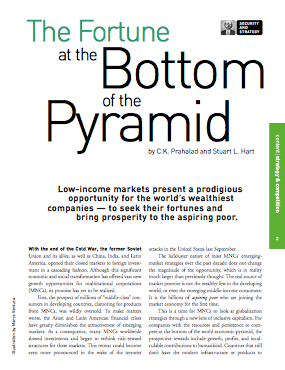
With C.K. Prahalad, I wrote the path-breaking article: The Fortune at the Bottom of the Pyramid which provided the first articulation of how business could profitably serve the needs of the four billion poor in the developing world.

Learn more about my work at stuartlhart.com >>

About this Archive

This page is an archive of recent entries in the Competition category.

Co-Creation is the previous category.

Conservation is the next category.

Find recent content on the main index or look in the archives to find all content.